As parents and educators we naturally feel a strong urge to protect our children and students, protect them form difficult things. But as life would have it; difficult and tragic things happen. A loved one dies or a child views something violent and scary on the news; and we are left feeling nervous about how to proceed. Here are some tips and resources I have gathered on this important process.
Thursday, September 12, 2024
Talking to Children about Difficult Topics
Thursday, November 30, 2023
5 things to remember when working with a challenging student
I recently came across a 'new to me' resource, the website for the National Center for Youth Issues. I am not quite sure what took me so long to discover this site but am so glad I did! There are so many great books and blog posts with a variety of topics. This is also a good social media follow.
I hope you all enjoy!
Tuesday, October 24, 2023
8 signs of Anxiety that show up as something else (Go Zen Article)
8 Signs of Anxiety in Children That Show Up as Something Else
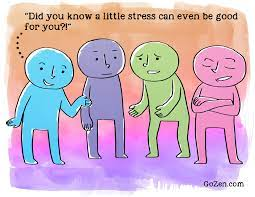
In this wonderful article put out by GoZen, we can see that Anxiety can be so multifaceted for our kids. The visual analogy of an iceberg is so poignant to help us realize there is such much more going on under the surface. Sometimes people see anxiety a certain way, perhaps as exhibited through tears or shyness, or seeking a lot of reassurance. However, the more we learn about anxiety the more we are learning that this can show up in many unexpected ways. Anxiety can look so different from child to child. Many anxious kids seek out to take control and this may manifest through avoidance or defiance. While other anxious kids may try to over-plan their little world to gain more control. Anxiety can also manifest as inattentiveness, when they're consumed with anxious thoughts it's hard for them to focus on what is in front of them. There may also be difficulty sleeping, anger and negativity.'Anxiety occurs when there is an overestimation of a perceived threat (e.g., a test or a party) and an underestimation of coping skills (e.g.,”I can’t handle this.”). '
When kids underestimate their abilities to cope with a certain situation they may feel helpless which can lead to frustration/anger. This may also be connected to what Brene Brown calls 'chandeliering', or when a seemingly calm child 'flies off the handle'. An anxious child can look nice and calm to the outside observer but their wheels are churning on the inside. I like to picture a duck on a pond, they look nice and calm from the top of the pond but underneath their feet are swimming rapidly. I found this article so helpful and I hope you will too. Please utilize the GoZen website as a great resource if you find yourself with an anxious child. https://gozen.com/
Monday, October 24, 2022
'Flip Your Lid'- Explaining how your brain and emotions work to kids
'Flip Your Lid'
Using a hand model to help explain how emotions work in our brain.
In a recent professional meeting, I was encouraged to learn more about the 'flip your lid' hand model to incorporate into some of my counseling sessions with kids. Dr. Dan Siegel who is a well known contributor to the field of child psychology coined the 'flip your lid' hand model to help explain how the brain works in a more accessible way. Shown above is a child friendly resource inspired by Dr. Dan Siegel called Mineola Grows! Mineola grows has several kid friendly videos helping to explain how our emotions work and the power of the amygdala and prefrontal cortex. I have used this with a few kids in sessions and I think it really can help to empower kids and aide in their regulation.
Friday, April 1, 2022
Test Anxiety Strategies
Here at Wheelock Elementary School, our third graders will be taking the MCAS testing next week.
I thought I'd share some great strategies for any of our students who may get nervous.
Here are some helpful tips and hints:
1. Get a good night sleep
2. Eat a good breakfast
3. Create a personalized positive mantra for your child
- "I've got this!"
- "I am smart and I am prepared"
- "Everyone makes mistakes"
- "It's okay to take my best guess"
4. Help children to re-frame their nervous feelings:
If your child feels jittery or a bit sweaty, you can help re-frame this by telling them it's their bodies way of getting them excited for the challenge ahead. Like an athlete getting nervous before a big game.
5. Make sure to myth bust:
- Taking the MCAS has nothing to do with whether kids go to fourth grade or not
(some kids have this misconception for whatever reason)
- Also, remind kids that they can have all day if they need to, the MCAS are indeed untimed
6. Focus on the positives, most teachers do not give homework the week of MCAS
and there's usually extra recess.
Also a little extra treat at home after their hard work never hurt anyone :)
Further resources/articles that inspired these strategies:
https://gozen.com/affirmations-to-bust-test-anxiety-rooted-in-science/
https://www.pbs.org/parents/thrive/six-ways-to-help-kids-tackle-test-anxiety
Friday, January 28, 2022
"I statements" and "I messages"
Wednesday, October 13, 2021
Book Spotlight 'Uniquely Wired' by Julia Cook
Today I had the pleasure of visiting a second grade classroom to read them a story titled 'Uniquely Wired', a beautifully written story about a young boy with Autism Spectrum Disorder. Julia Cook is the author of this wonderful book and she has written a large variety of books to support social/emotional growth in children. 'Uniquely Wired' helps both children and adults better understand Autism. The story is told from the perspective of a young boy Zak who explains how he responds to the world differently. These differences are viewed as gifts that Zak gives others around him. I truly believe knowledge is power and this class not only gained a better understanding of Autism Spectrum Disorder, they demonstrated even more acceptance and tolerance towards our students who may be viewed as different.
Thursday, January 7, 2021
Resources to support events from January 6th 2021
Yesterday's events from the violent outbreak and breach of the US Capitol has us all feeling very distraught and unsettled. Here are some resources with tips on how to handle and support our children after such an unfortunate event. We have a responsibility to ensure our children feel safe and supported. I hope that we can all have meaningful conversations with our kids and with each other about the importance of being tolerant, respectful and accepting of others. I believe we can empower our youth to be the change we wish to see in the world.
Here is another great resource Dr. Marsden has shared with us:
Responding to violence at the Capitol
Monday, September 14, 2020
Talking to your kids about coming back to school
Welcome and welcome back to some families as we begin the 2020-2021 school year at Wheelock. I am very excited to see the students again. However, I am sure many families have a 'mixed bag' of emotions. Teachers and staff are working so hard to ensure a safe and welcoming return to school. Myself and Mrs. Bockhorst (our part time counselor) have put together some talking points we thought would be helpful for families.
What to do if your child is feeling worried:
Normalize - It is common to feel worried before we do something new, for both kids and adults
Remind of prior successes - help your child think of a time they did something they overcame their nerves
Practice relaxation strategies
- Deep breaths - Roller Coaster Breathing
- Positive mantra - “I can do hard things.”
How to help your child adapt to wearing masks
Explain: Wearing a mask helps protect ourselves and other people
Take a picture of you and your student wearing the mask
Practice:
start small and build up from there
take small trips to libraries or stores so that kids can begin to practice mask wearing
Wear the mask during a preferred activity like ipad time
Play pretend with the mask, try putting a mask on your stuffed animal
Have fun picking a mask, let your child get to chose
Practice what your child can say if another student takes off their mask - “Oops, don’t forget your mask.”
3. Explain how staying 6 feet apart keeps you safe
- Help your child recognize how far 6 feet is
Measure it out together
Draw it with chalk
Airplane Arms
Help your child rehearse what to say if someone is too close “Please remember six feet apart!” “Whoops, we have to remember our space”
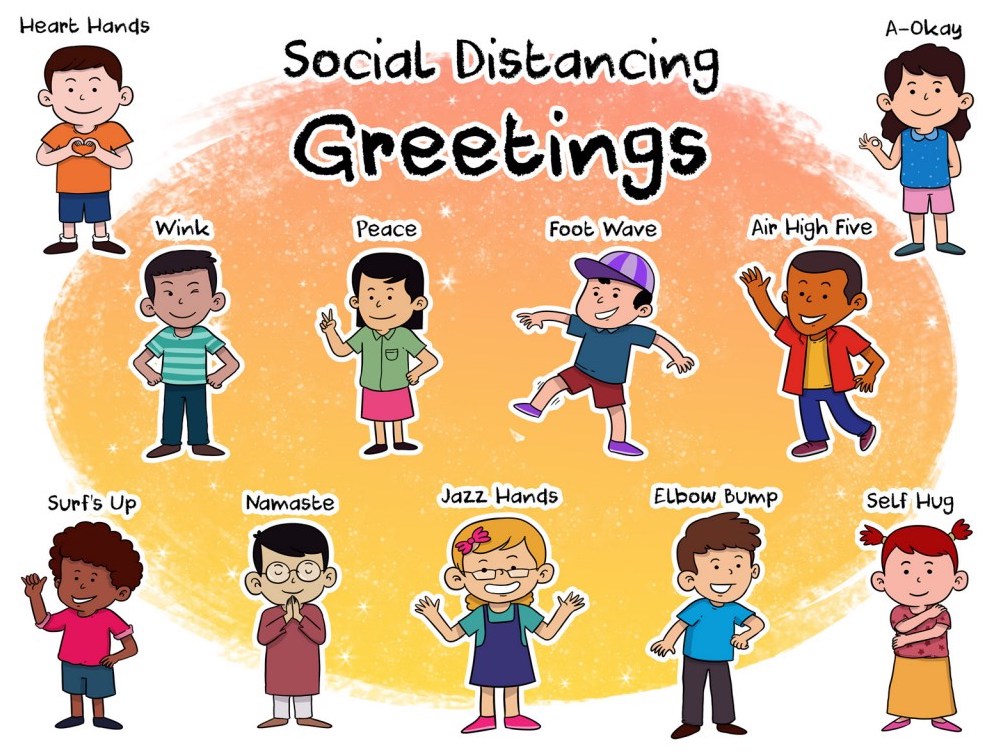
Saying Hello/Greeting Friends - Prepare your child that they can greet their friends with all sorts of friendly “hellos” from a distance
Friday, June 5, 2020
Resources to help talk to kids about racism
Thursday, March 12, 2020
Talking to Children about Covid-19
In an effort to help support the any anxiety about the ongoing concern of the Corona virus or Covid-19, I am going to share two very helpful resources. The first is an article from the National Association of School Psychologists (NASP) with good talking points.
https://www.nasponline.org/resources-and-publications/resources-and-podcasts/school-climate-safety-and-crisis/health-crisis-resources/talking-to-children-about-covid-19-(coronavirus)-a-parent-resource
This next resource is set up in a comic format and may or may not be appropriate to share with your kids, based on your judgement.
https://www.npr.org/sections/goatsandsoda/2020/02/28/809580453/just-for-kids-a-comic-exploring-the-new-coronavirus
I hope you find these resources helpful.
Wednesday, January 29, 2020
Supporting Your Child with a Disability
Wednesday, November 20, 2019
Words Matter
Monday, September 9, 2019
Talking to your children about their differences
1. Start by talking about how everyone has strengths and weaknesses
- there is no one person who is good at everything
- talk to your child about what you are good at and what is not easy for you
- help to point out specific examples for yourself and your child
2. Empower and encourage
- help them build a positive attitude about their difference(s)
- acknowledging their areas of difficulty will help fuel their self advocacy
- helping them to understand what strategies work for their areas of difficulty
For example:
"We know that you have trouble focusing and listening, so remember to ask the teacher to sit in the front or ask for a quick brain break"
- sometimes practicing (role playing) what to say if other kids ask them questions about their differences can help them feel prepared
For example: "Hey why do you wear glasses now?", "I have these new glasses because I used to see double when I looked at the board, boy what a relief!"
3. Partnering with schools/teachers to communicate and collaborate about supporting your child will be key
- Be sure to reach out to your child's teacher and/or specialist to keep the communication open
4. Other tips for talking to your kids about this topic:
- "Your challenges do not define you"
- "I know it can be uncomfortable to talk about this, I am here to listen"
- It's important to keep this conversation going, especially as kids get older and interpret things different at different developmental points
- Praise progress and effort (not just end results)
- Provide honest and specific compliments over frequent general praise (i.e. I like how hard you tried to figure out that math problem vs. good job)
- watching videos of other kids or researching famous people who also have learning differences or other disabilities can better put things in perspective for kids
It's very common for kids with any type of learning or social/emotional difficulty to display some self esteem concerns. Helping to empower our kids to acknowledge their area of difficulties will help to eventually make them feel more liberated. They will soon learn about friends and classmates that also have differences/weaknesses.
I hope this information has been helpful, like I said there are so many great resources on this topic but here are a few I thought were particularly good:
https://www.imdetermined.org/
https://childmind.org/article/how-to-help-kids-talk-about-learning-disabilities/
https://www.understood.org/en/learning-attention-issues/understanding-childs-challenges/talking-with-your-child/how-to-talk-to-your-child-about-learning-and-attention-issues
Wednesday, April 10, 2019
New Article about Childhood Anxiety
Thanks for visiting!
Thursday, February 7, 2019
Stopping Negative Thoughts and Calming Apps
We all know a lot about growth mindset, changing our thinking from "I can't" to "I just haven't done it YET". This type of coaching to re-frame their thinking is invaluable but Jessica also focused a lot on stopping the negative thoughts by intervening early on. Often times, we may leave kids to do independent tasks or homework for several minutes. Within this time frame of just minutes, our anxious kids can have a flood of negative thoughts. "I can't do this" "I'm so bad at math" "This is going to take all night". Anxiety can cause all kinds of incorrect or catastrophic thoughts. Jessica's advice is to help kids get started, set them up for success and then let them do things independently.
Another great tip Jessica encouraged us all to think about is what types of breaks we are giving our anxious kids. Often times we go for a walk or let kids color for a few minutes. Not to say these aren't great strategies for some kids, but it may not work for others, since negative thoughts can still occur during a walk or while coloring. Jessica encouraged us to think about 'cognitive' breaks, or a way to distract our mind in a positive way so that we can stop the obtrusive thoughts. For example, games like 'soduku' or cross words puzzles can help get our mind off negative thoughts. Or even singing a favorite song and reciting lines from their favorite movie. Jessica was also so kind to provide some great App to help as calming breaks or cognitive breaks. I have tried the 'Calm' app myself and loved it! Here is a list:
- Calm
- Headspace
- Moodnotes ($)
- Moodpath
- Pacifica
- Pixel Thoughts
- Happify
- Talkspace
- SugarBetter
- 7 cups
Tuesday, August 21, 2018
Hello and Helpful segment for back to school anxiety

Thursday, February 15, 2018
Monday, December 4, 2017
'Rethinking Strategies for Anxiety and Opposition'

- Brainpop video
- crossword puzzle
- Mindfulness minute
- Go noodle
- Often our tricky kids struggle to stop/end activities, so not only using a time timer but teaching them what is a ‘stopping plan’
- After giving a give minute warning, asking them ‘what is your favorite minute stopping plan?’
- Or telling them what a good stopping plan is- five more minutes is… two more pages of the book, ten more points in a game, etc.
- Give them a pausing point (with visual)
- Instead of ‘Stop Tapping your pencil’ or ‘Sit up Straight” ---->Say ‘Can you check yourself’- promoting self assessment
- Help children to re-frame ‘All or Nothing” thoughts to a smaller more manageable problem
5
|
3
|
4
|
2
|
5
|
2
|
Friday, November 17, 2017
Exciting Honor